
Marathon Calculator
A goal time is only useful if you know what it means at mile 8, at halfway and at 20 miles. Enter your target and start time, choose how you want to pace it, and this calculator builds the whole race plan — splits, clock times and when to take each gel — ready to print as a pace band.
- Free to use
- No sign-up
- Runs in your browser
Marathon race plan
Marathon Training and Race Plan Pack
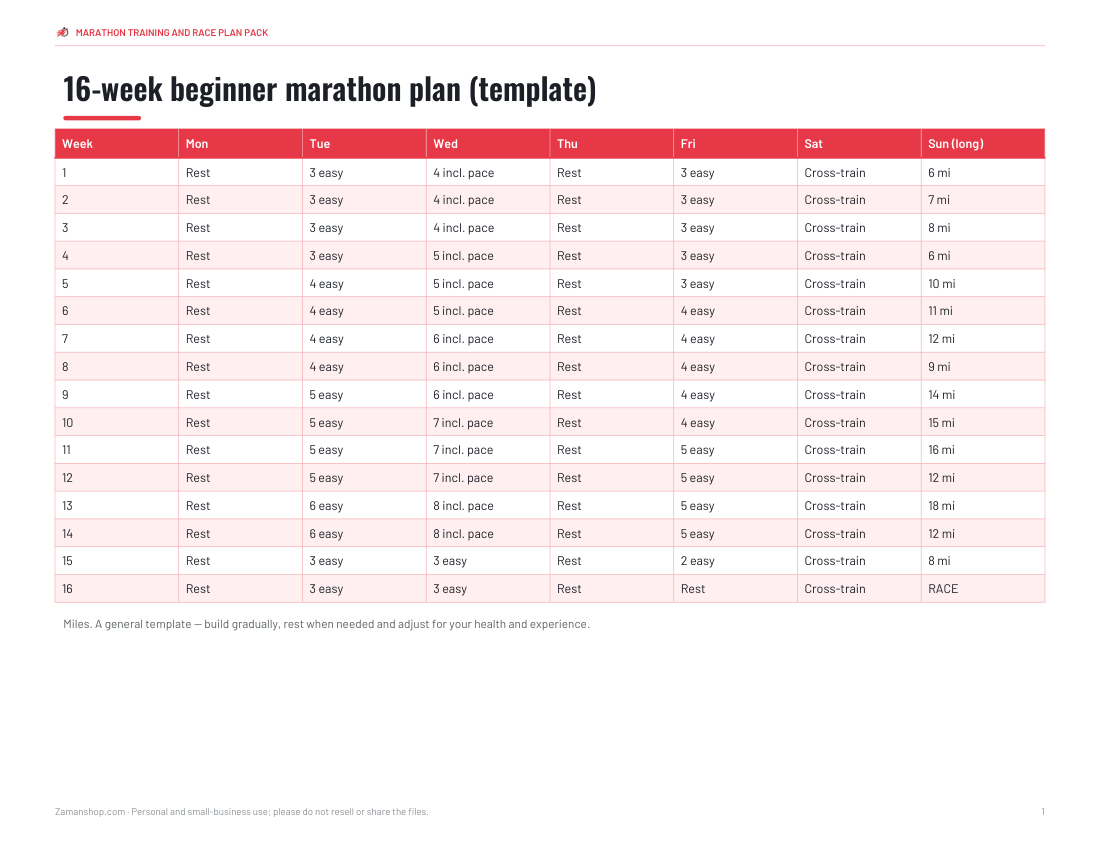
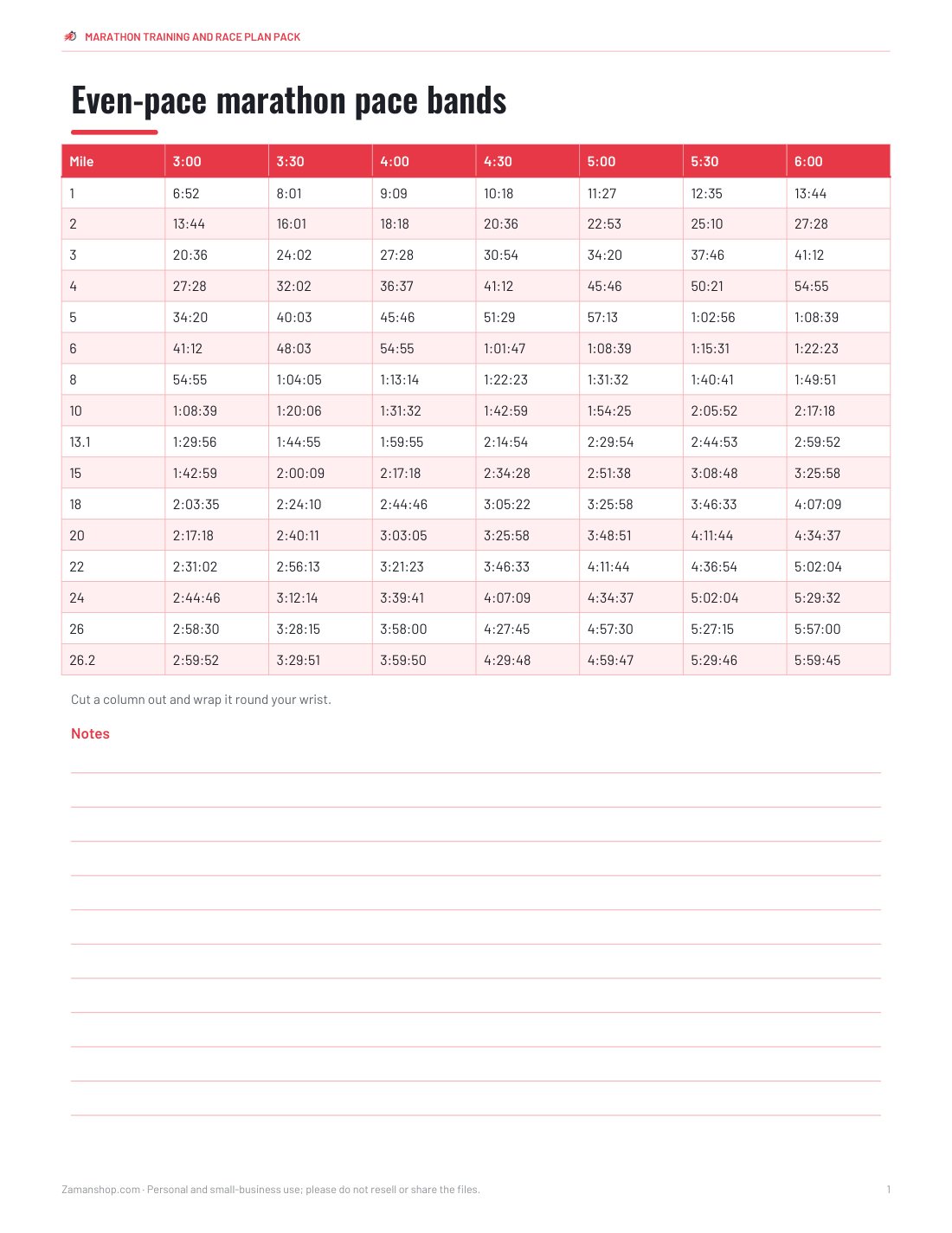
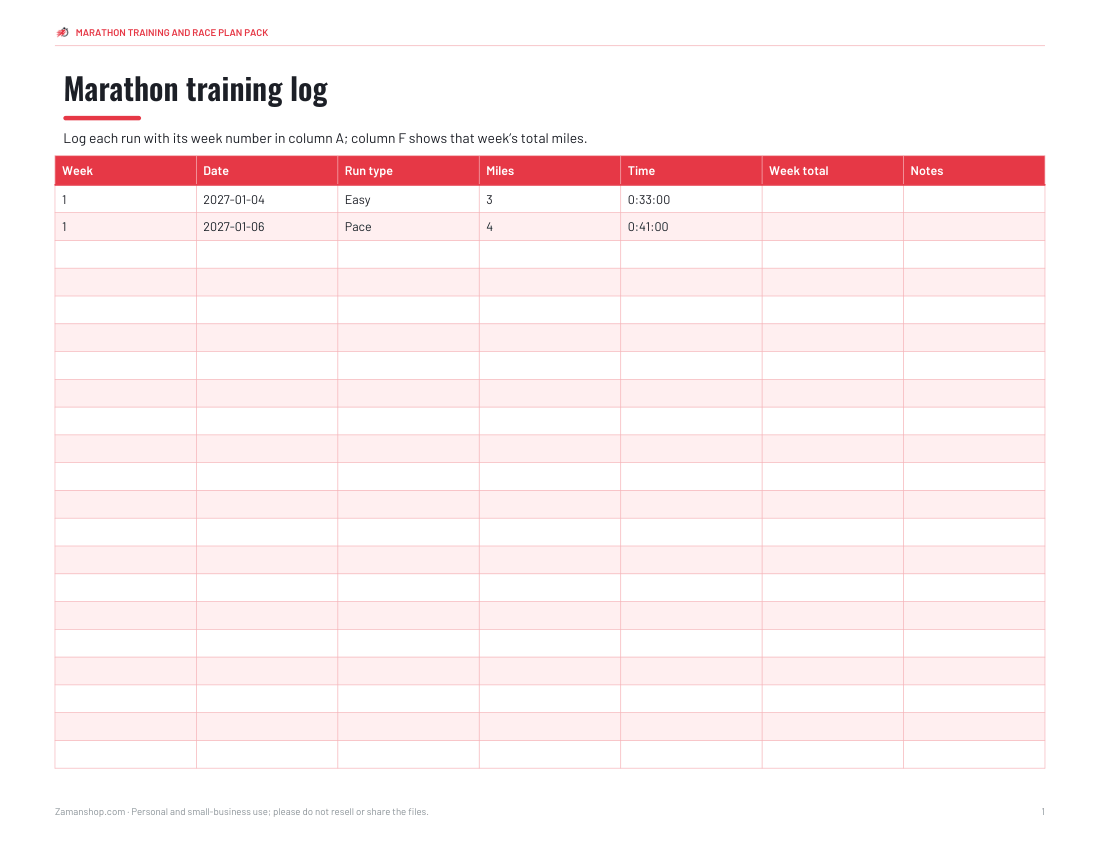
16- and 18-week marathon training plan templates, printable pace bands from 3:00 to 6:00, a training log spreadsheet, a race-day checklist and fuelling worksheet, and a half marathon pace chart.
- 16-week plan (PDF/DOCX)
- Pace bands (PDF)
- Training log (XLSX)
- Race-day checklist (PDF/DOCX)
- Fuelling worksheet (PDF/DOCX)
- Half marathon chart (PDF/DOCX)
Formats: PDF, DOCX, XLSX. Instant download after payment (link valid 72 hours, up to 5 downloads). AI-assisted: the templates were drafted with AI help and reviewed and laid out before publishing.
$5.00 USD, one-time 6 files · about $0.83 each
- Instant download
- 7-day refund
- Secure checkout by Stripe
7-day money-back guarantee. Full refund within 7 days of purchase, even after you download.
Free sample: Marathon Plan 16 Week (PDF, 63 KB)
Full refund within 7 days — see the refund policy and license.
Free printables
Single sheets you can print right now, no sign-up. The full pack adds every sheet in one download plus the editable files.
 Printable 16-Week Marathon Plan1 page · free PDF
 Printable Marathon Pace Bands1 page · free PDF
 Printable Marathon Training Log6 pages · free PDF
 Printable Marathon Race-Day Checklist1 page · free PDF
 Printable Marathon Fuelling Worksheet2 pages · free PDF
 Printable Half Marathon Pace Chart1 page · free PDF
Marathon goal times and paces
| Goal | Pace per mile | Pace per km | Halfway (even) |
|---|---|---|---|
| 2:30 | 5:43 | 3:33 | 1:15:00 |
| 3:00 | 6:52 | 4:16 | 1:30:00 |
| 3:15 | 7:26 | 4:37 | 1:37:30 |
| 3:30 | 8:01 | 4:59 | 1:45:00 |
| 3:45 | 8:35 | 5:20 | 1:52:30 |
| 4:00 | 9:09 | 5:41 | 2:00:00 |
| 4:30 | 10:18 | 6:24 | 2:15:00 |
| 5:00 | 11:27 | 7:07 | 2:30:00 |
| 5:30 | 12:35 | 7:49 | 2:45:00 |
| 6:00 | 13:44 | 8:32 | 3:00:00 |
A marathon is 42.195 km (26.219 miles). Courses are measured along the shortest possible route, so most runners cover a little extra distance weaving through the field — GPS watches often read 26.4–26.5 miles at the finish.
Even or negative splits?
Most coaches recommend running the marathon at an even effort, and many successful races are run with a slight negative split — the second half a little faster than the first. Starting too fast is the classic mistake: the glycogen you burn early is gone when you need it after 20 miles. A 2% negative split for a 4-hour marathon means a first half of about 2:01:13 and a second half of about 1:58:47. Hilly courses, heat and wind all justify pacing by effort rather than the watch.
Worked example
A runner aiming for 4:00:00 with a 7:30 start chooses a 2% negative split, splits every mile and a gel every 40 minutes. The plan shows an average pace of 9:09 per mile, a first half of 2:01:13, halfway at about 09:31 on the clock, and five gels, marked on the miles where each 40-minute interval falls. They print the pace band, wrap it in clear tape and wear it next to their watch.
Fuelling and fluids
- Carbohydrate: many guidelines suggest roughly 30–60 g per hour for events over two hours, and some trained athletes use up to 90 g with practice.
- A typical gel has about 20–30 g of carbohydrate — check the label.
- Take gels with water, not sports drink, unless you’ve practised that combination.
- Drink to thirst; many runners need roughly 400–800 ml per hour depending on heat and body size, and over-drinking can be dangerous.
- Rehearse the plan on long runs so your stomach is used to it.
Choosing a realistic goal
The best predictor of your marathon time is a recent race over a shorter distance run in good conditions, combined with how consistently you’ve trained. A half marathon time doubled plus roughly 10–20 minutes is a common rough guide, but it assumes marathon-specific training with long runs of 18–20 miles. First-time marathoners often do best by choosing a conservative goal and running the first half by feel. If race-day weather is hot or humid, adjust the goal: many runners slow by several percent in warm conditions, and it is far better to finish strongly than to fade.
Using the splits during the race
| Section | What to focus on |
|---|---|
| Miles 1–3 | Hold back; stay at or slightly slower than the band |
| Miles 4–13 | Settle into rhythm; take the first gels on schedule |
| Miles 14–20 | Keep effort steady; check the band every mile |
| Miles 20–24 | Concentrate on form and fuelling; this is where pacing pays off |
| Last 2 miles | Use what’s left — the negative split starts to show |
A small time gap on the band — 10 or 20 seconds — is nothing to chase. Close it gradually over several miles.
Pacing tips for race day
- Line up in the corral that matches your goal.
- Run the first 5 km slightly slower than goal pace — it will feel easy.
- Check the pace band at each mile and adjust gradually rather than surging.
- Run the tangents: take the shortest line through bends.
- At 20 miles, reassess: if you have energy, gradually lift the pace.
What’s in the template pack
- 16-week marathon training plan template (beginner) and 18-week plan (intermediate)
- Printable pace bands for goal times from 3:00 to 6:00
- Training log spreadsheet with weekly mileage totals
- Race-day checklist and fuelling plan worksheet
- Half marathon pace chart
The calculator is free; the pack is a one-time download. Training plans are general templates — adjust them to your experience and health, and consult a professional if you have medical concerns.
AI-assisted content
This page and the templates were drafted with AI assistance and reviewed before publishing.
Frequently asked questions
What pace is a 4-hour marathon?
About 9:09 per mile or 5:41 per km.
What is a negative split?
Running the second half faster than the first.
How many gels do I need for a marathon?
Often 4–7, depending on your finish time and each gel’s carbohydrate.
How long is a marathon?
42.195 km or 26.2 miles.
How do I choose a goal time?
Use a recent shorter race and your training history, and be conservative for your first marathon or in hot weather.
Why does my watch show more than 26.2 miles?
Courses are measured on the shortest line; weaving and GPS error add distance.
What is a pace band?
A wristband listing the target elapsed time at each mile or kilometre.
Is the pack a subscription?
No, it’s a one-time download.